You know that feeling when your favourite restaurant suddenly can’t take card
payments… or your delivery arrives three days late because “the system was down”?
Well, welcome to the new global reality — where cyberattacks aren’t just hitting
laptops and servers, they’re targeting the very systems that keep the world running.
And the alarms are getting louder.
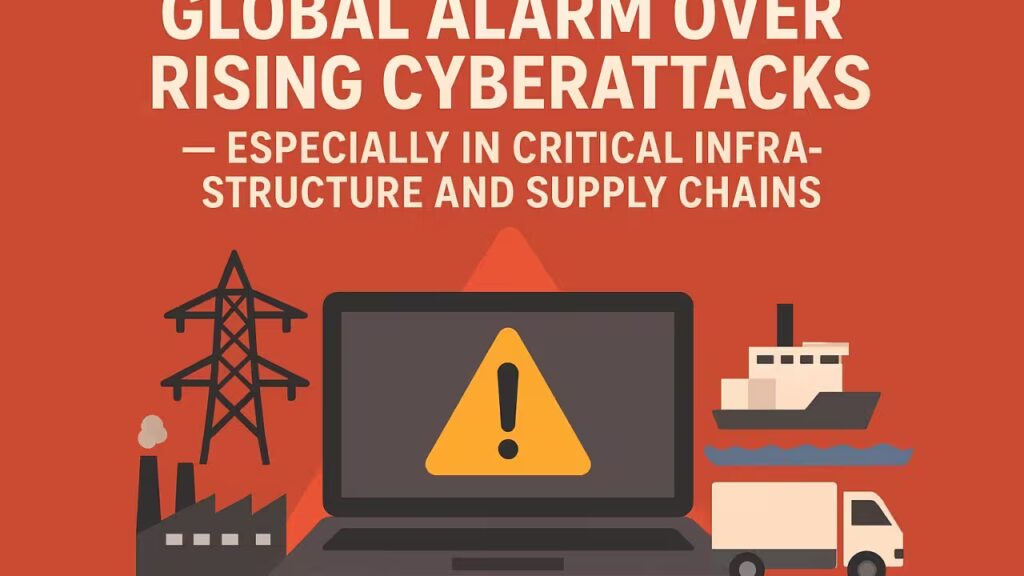
Across the last year, hospitals, energy grids, ports, water treatment facilities,
manufacturing plants, logistics networks, and even the software that ties them all
together have seen a surge in coordinated cyberattacks.
Not small ones — critical infrastructure-level hits that ripple across entire countries,
sometimes across continents.
But here’s the surprising part:
Most people still think, “This doesn’t affect me.”
Let’s fix that.
- Cyberattacks aren’t staying in the IT department — they’re jumping into real life
When a supply-chain system is hacked, it’s not just a cybersecurity problem.
It becomes a:
● Business problem
● Customer-experience problem
● Logistics problem
● Economic problem
● Sometimes… national security problem
A single compromised software supplier can halt factories, delay medicines, freeze
payments, disrupt transport, or mess with product availability — even if your business
was never the target.
Cyberattacks have gone from “digital inconvenience” to “real-world disruption.”
- Attackers are thinking bigger — and smarter
Modern threat groups aren’t guessing passwords anymore. They’re:
● Targeting the software that entire industries depend on
● Exploiting trusted third-party vendors
● Embedding themselves in hypervisors and virtualization layers
● Attacking upstream providers to reach thousands downstream
It’s no longer about attacking one company.
It’s about attacking every company that relies on the same chain.
It’s efficient.
And terrifyingly effective.
- Why these matters to YOU (yes, you)
Because critical infrastructure is literally the stuff you touch every day:
Your food arrives because supply chains work
Your payments go through because financial networks stay online
Your water is clean because control systems remain secure
Your lights stay on because grids are protected
Your deliveries show up because logistics systems weren’t compromised
Your hospital visits go smoothly because healthcare systems weren’t encrypted
Cybersecurity isn’t a “tech thing” anymore —
it’s a societal function.
- So what do we do?
Not panic.
But prepare differently.
Organizations need to:
● Map their supply-chain dependencies (most don’t… yet)
● Demand transparency from vendors
● Patch and monitor critical systems early and aggressively
● Build incident plans that include supply-chain breakdown scenarios
● Treat cyber risk as a board-level and national-level priority
And individuals?
We need to stay aware, skeptical, and informed.
Digital literacy is no longer optional — it’s survival.
- The fun twist: Cyber resilience is becoming a team sport
Here’s a positive angle:
This global shift is forcing companies, governments, and everyday people to
collaborate in new ways.
We’re seeing cross-industry intel sharing, coordinated defense networks, and more
conversations about digital trust than ever before.
And honestly, that’s a win.
Cyberattacks are getting bigger —
but so is our collective understanding.
Final Thought
The rise in cyberattacks on critical infrastructure isn’t a future headline — it’s today’s
reality.
But it’s also an opportunity:
An opportunity to rethink security, rebuild trust, and strengthen the systems that
keep the world moving.
Because when cyber risks hit the real world…
we all have a part to play.